Eight years after genocide, the Rohingya remain abandoned to starvation and silence

Eight years after genocide, the Rohingya remain abandoned to starvation and silence

By Tun Khin

Once promised protection and justice, the Rohingya now face a collapsing refugee response in Bangladesh, deliberate starvation in Myanmar, and abandonment by the international community.
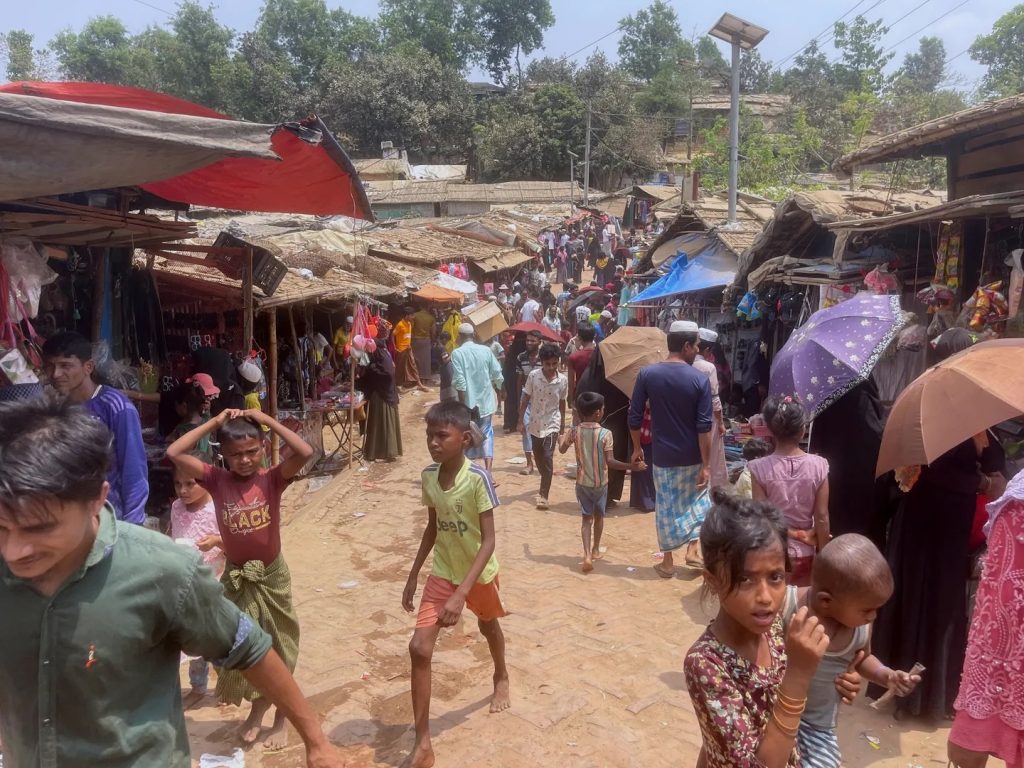
More than a million Rohingya refugees remain trapped in Cox’s Bazar, Bangladesh (AP).

In August of 2017, the world saw satellite images from Myanmar of entire Rohingya villages being burned to the ground. Survivors described unimaginable horror, the systematic massacre of men, women, and children, as more than 700,000 were forced to flee across the border to Bangladesh.

The United Nations called it genocide, and world leaders collectively condemned the atrocities, while promising to deliver protection and accountability.

Eight years on, those promises have largely given way to silence. In 2025, the Rohingya remain dispossessed, trapped, and abandoned – caught between a collapsing humanitarian response in Bangladesh and the continuation of genocide inside Myanmar.

For those who escaped the mass killings in Myanmar, life in exile has brought a different kind of struggle. Cox’s Bazar, now the world’s largest refugee camp, holds more than 1.1 million Rohingya struggling to survive.

New arrivals, fleeing continued violence and hunger in the country, are pouring into camps that were already collapsing under inhumane conditions.

Refugees remain banned from working, leaving them entirely dependent on shrinking aid. With more than half the population being children, 40 percent were already stunted by malnutrition. This year, brutal aid cuts have caused further devastating consequences.

These cuts stem largely from a global funding crisis, as major donors such as the United States and United Kingdom scale back contributions to the Rohingya response, leaving essential needs like food, healthcare, and sanitation critically underfunded.

Education centres are closing, children are going hungry, and an entire generation faces abandonment to illiteracy and despair.

Starvation as a weapon in Rakhine
In November 2024, the UN was already warning that famine was imminent in Rakhine State, with more than two million people at risk. Since then, the Myanmar’s military has tightened blockades and restrictions, deliberately starving civilians.
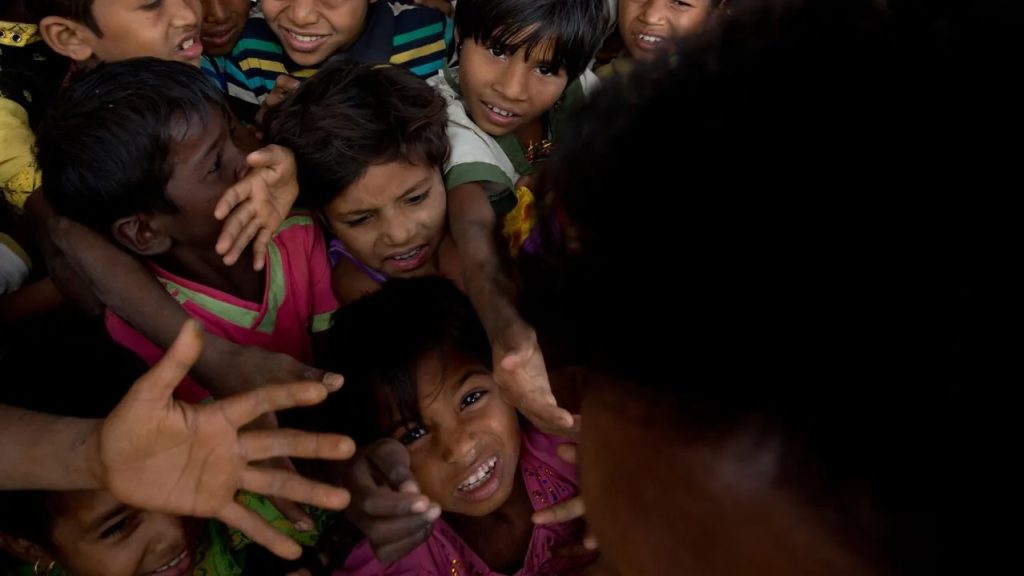
Rohingya children in Cox’s Bazar, Bangladesh, face worsening conditions eight years after fleeing genocide (AP).

In Sittwe, Rakhine’s capital, more than 120,000 Rohingya remain confined to camps, surviving on scraps of taro root and sweet potato.

A recent report by Burmese Rohingya Organisation UK (BROUK), Starving to Death, details how the military has replaced bullets with starvation as its primary weapon of genocide.

The rise of the Arakan Army (AA) in Rakhine, which has seized large areas of the state from Myanmar’s army, has left the Rohingya trapped between two oppressors. The military continues its strategy of starvation – blocking trade and aid – while the AA enforces anti-Rohingya policies: denying identity, restricting movement, extorting “fees,” and profiting from human trafficking.

Detention is used as a weapon of intimidation, and Rohingya are routinely arrested without due process, held for ransom, or ordered to leave the country under threat of re-arrest.

Victims often vanish in custody or report severe abuse upon release. Human Rights Watch recently documented AA abuses, including forced labour and recruitment, while Fortify Rights, an NGO with long-standing expertise in the region, has called for an ICC investigation into AA war crimes, from abductions to mass killings and beheadings of Rohingya civilians.

These abuses form part of a broader campaign of violence and displacement. For the Rohingya, the AA represents a second wave of persecution and a continuation of genocide. Both Myanmar’s army and the AA continue atrocities with impunity.

Broken promises
The international community has failed us. Political attention is shrinking, and funding pledges go unmet. The world that once declared “never again” has turned away.

International justice mechanisms, which should offer hope to the Rohingya and pave the way for peace and reconciliation in Myanmar, have failed to deliver.
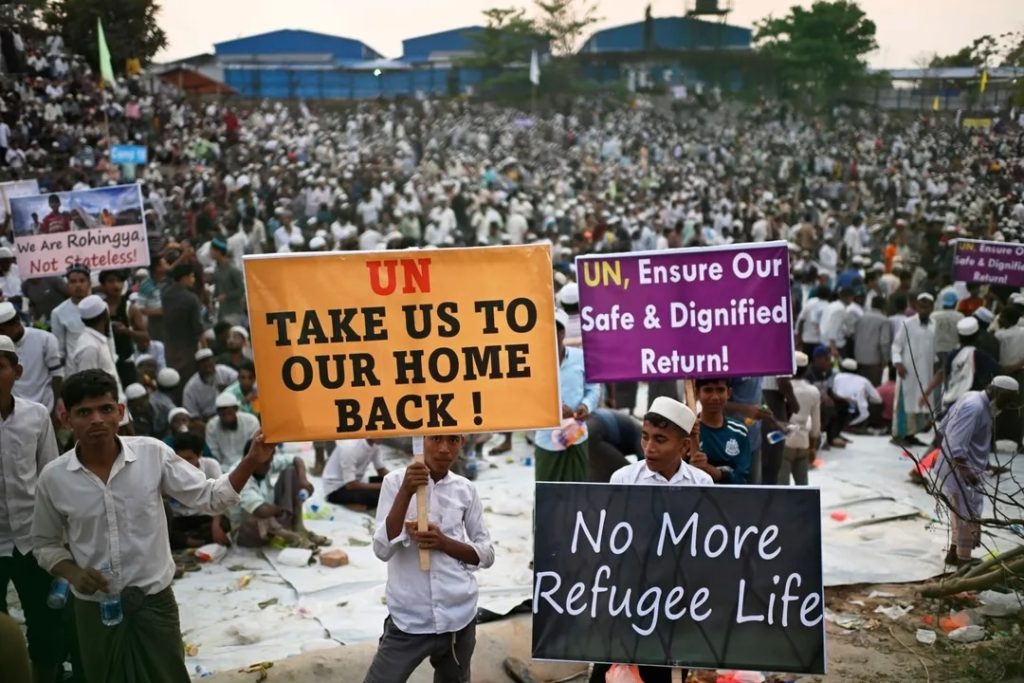
Many Rohingya feel let down by the international community (AP).

Proceedings at the International Criminal Court and the International Court of Justice have yet to provide meaningful accountability, while the only arrest warrants to date have come from the Rohingya-led universal jurisdiction case in Argentina.

Beyond this, the international community’s failure to act decisively has left the Rohingya without justice and even less trust in global mechanisms meant to protect them.

What must change
Next month’s UN High-Level Conference on the Situation of Rohingya Muslims and Other Minorities in Myanmar must not be another symbolic exercise. It must deliver urgent, concrete outcomes:

  • Fully fund humanitarian aid to meet immediate needs in both Bangladesh and Myanmar. Aid cuts must be reversed to prevent mass starvation, especially among children.
  • Lift blockades in Rakhine State. Maximum pressure must be exerted on Myanmar’s army to end its weaponisation of starvation by immediately lifting trade and aid blockades and allowing unrestricted humanitarian access.
  • Pursue and enforce international justice. Both Myanmar’s military and the Arakan Army must be held accountable for their crimes against the Rohingya. Armed struggle does not excuse persecution, extortion, trafficking, or executions.
  • Convene the UN Security Council to address Myanmar’s failure to comply with the ICJ’s binding order to protect the Rohingya, and to press for referral of crimes to the ICC.
  • Impose targeted measures. Coordinated multilateral efforts are needed to enforce a global arms embargo, halt the transfer of aviation fuel to the military, and impose targeted sanctions on Myanmar’s military, its leaders, and its sources of revenue.
  • Guarantee Rohingya representation and protection. Durable solutions cannot be imposed on us. Rohingya must be involved in shaping their future, with guarantees for safe, voluntary, and dignified return to their homes and land.
  • Support Bangladesh. The international community must increase support to Bangladesh to ensure food, medicine, shelter, education, and livelihoods for Rohingya refugees, while ending harmful restrictions on work and education in the camps.

Famine in Rakhine is not inevitable. Starvation in Cox’s Bazar is not inevitable. Another lost generation is not inevitable. All are preventable – if the world takes the opportunity to act.

Doing nothing is not neutral; it is a choice to let genocide continue. History will remember not only the generals who torched our villages in 2017, but also the silence and broken promises that followed.

This op-ed was originally published by TRT Global on August 26, 2025.
The Rohingya Tragedy: Eight Years of Suffering and the Call for Justice

The Rohingya Tragedy: Eight Years of Suffering and the Call for Justice

By Maung Emdadul Hasan

On the twenty-fifth of August, we pause to remember a sorrowful chapter in human history. Eight years ago, the sun rose over the verdant plains of Rakhine/Arakan State, Myanmar, only to witness the eruption of unspeakable cruelty. The Myanmar military, in a campaign of relentless violence, descended upon peaceful Rohingya villages. Entire communities were reduced to ashes; men were slain in cold blood, women and girls subjected to the vilest forms of assault, and the elderly left to perish without aid. Thousands fled, crossing rivers and jungles, seeking refuge in neighbouring Bangladesh.

Thus began a calamity that has persisted into the present day, a calamity not confined to the past but recurring, as armed forces and insurgent factions alike continue to tear apart the social fabric of Rakhine, leaving the Rohingya to endure years of exile, statelessness, and uncertainty.

The Origins of Persecution
To comprehend the tragedy of 2017, one must look beyond that single night of terror. The persecution of the Rohingya is a story decades in the making. Since the military coup of 1962, policies of marginalization, deprivation, and disenfranchisement were systematically applied. The 1982 Citizenship Act stripped the Rohingya of their legal identity, rendering them foreigners in their own homeland. Movement was restricted; education, employment, and civil rights were denied. Periodic outbreaks of violence, in 1978 and 2012, forced waves of Rohingya to seek sanctuary beyond Myanmar’s borders (Cowley & Brinham, 2014).

By 2017, the Rohingya had been reduced to a community living in constant fear, their lives subject to the whims of a government and military apparatus that denied their very existence.

The Night of Horror: 25 August 2017
On that fateful night, the military’s scorched-earth campaign left a trail of devastation. Villages burned, families shattered, and over 6,700 Rohingya souls perished within a month, including hundreds of innocent children (BBC, 2017). Those who survived fled to Bangladesh, where they joined the swelling ranks of refugees in Cox’s Bazar, now the world’s largest refugee settlement. Here, they subsist in fragile shelters, dependent upon international aid for sustenance, shelter, and healthcare.

Violence Persists: The Arakan Army Atrocities
The calamity did not end with the 2017 exodus. In 2024, the Arakan Army, a regional armed faction, committed massacres in Htan Shauk Kan (Hoinya Seeri) village, killing over six hundred Rohingya, and again in August, near the Naf River, where nearly two hundred more perished (ARNC, 2025). Families were uprooted once more, their ancestral lands seized, their homes reduced to ash. The world watched silently as new waves of violence compounded the misery of an already suffering people.

The Voice of the Rohingya: ARNC Speaks
The Arakan Rohingya National Council (ARNC) has consistently amplified the call for justice and accountability.

U Nay San Lwin, Co-Chair of ARNC, addressed international media about the Htan Shauk Kan massacre and the ongoing plight of Rohingya in northern Rakhine, highlighting the continued persecution and the urgent need for protection.

Mr. Anwar Arkani, Co-General Secretary of ARNC, asserted:
“The Burmese government is the criminal – rapists, murderers, arsonists. They have committed every crime in the dictionary, yet they are still free. Myanmar has long been a ‘refugee-producing factory’.”

U Nay San Lwin, activist, drew attention to decades of media bias:
“For years, Rohingya voices were silenced in Burmese-language media, while English media selectively used our identity to secure foreign funding. The Arakan Army massacred hundreds of our people, yet international coverage remains scant.”

U Tun Khin, Chairperson of ARNC, calls upon the global community to act decisively. In a joint declaration with 57 other organizations, ARNC demands:

1. Independent investigations into atrocities by both Myanmar military and Arakan Army.
2. Accountability through international tribunals.
3. Safe and dignified return to ancestral homes.
4. Protection of human rights for Rohingya still in Myanmar.

A Seven-Point Roadmap for Justice
Nobel Laureate and Chief Adviser of the Interim Government of Bangladesh, Prof. Muhammad Yunus proposed a measured course of action:

1. Secure the right of return for Rohingya.
2. Continue and strengthen humanitarian support.
3. Halt all violence and persecution.
4. Engage in dialogue and reconciliation.
5. Mobilize regional and international actors.
6. Stand firmly against ethnic cleansing.
7. Ensure justice through international mechanisms.

The Refugee Crisis in Bangladesh
The refugees of Cox’s Bazar endure lives of extreme precarity. Over one million Rohingya depend on aid for food, water, health, and education. Funding reductions threaten to collapse the fragile infrastructure of survival, placing countless lives in jeopardy (UNHCR, 2025).

Voices from Our Community
During the Stakeholders’ Dialogue on the Rohingya Situation in Cox’s Bazar, numerous brave representatives shared their experiences and the current reality of our people:

Sahat Zia Hero, a Rohingya photographer and activist, spoke about the ongoing oppression in AA-controlled areas, urging the world to pay attention to the daily struggles of Rohingya communities.

Hujjat Ullah, a young Rohingya activist, highlighted the hardships of survival:
“Skipping a meal to save for another to live one more day has become normal. I couldn’t control my tears when a friend told me that an elderly man received only a small amount of beef on Eid ul-Adha, without rice, oil, spices, or other essentials to prepare food. Media restrictions prevent the world from seeing the true suffering of our brothers and sisters.”

He emphasized that real solutions begin by listening to those who face these challenges, valuing their ideas, and including them in decision-making processes. He praised the interim government of Bangladesh for their efforts to address gaps and uplift essential issues.

M. Furquan Mirza, a teacher, and activist, reflected on the courage of the community representatives:
“For the first time in eight years, Rohingya representatives stood on stage alongside global figures, speaking with one united voice on behalf of over a million people. Their bravery, clarity, and determination bring pride to our entire community. They are our last hope and our opportunity for change.”

Juaitun Nahar, a youth activist and a photographer, recounted decades of persecution:
“In 2012, as a ten-year-old, I witnessed bloodshed and brutality. In 2016, I saw homes burned and massacres. In 2017, I survived the largest Rohingya genocide, including killings, disappearances, and crimes against humanity. From 2024, extremist AA attacks have continued, with drones, stabbings, and drownings in the Naf River. Yet no perpetrator has been held accountable.”

Khin Maung Thein, a Rohingya photographer and activist, shared the significance of our flag: “On this 8th Anniversary, our people united under the Rohingya flag, a symbol of our history, dignity, and struggle for justice. Raising our flag beside the Myanmar flag sends a message to the world: our existence cannot be erased, and our voice cannot be silenced. We are an inseparable part of Myanmar, yet a people with our own identity, culture, and rights.”

Maung Emdadul Hasan, a teacher, a poet, a researcher, expressed gratitude to the Bangladeshi people for their solidarity:
“Your unwavering support during the commemoration of 25 August and for raising our flag alongside us will forever be remembered. Let this flag remind the international community that the Rohingya will never give up the fight for justice, citizenship, and safe return to our ancestral homeland in Arakan.”

Community Recognition and Global Representation
To all the dedicated voices — Khin Maung Thein, Jaitun Nara, Zia Hero, Ro Khin Maung, Hujjat Ullah, M. Furquan Mirza, Sayed Ullah, Lucky Karim, Tun Khin, Nay San Lwin, Anwar Arakani, Shamsul Alam Saan Yu, Nasir Zakaria, and many others — your courage and dedication have made the entire community proud. You have brought our struggles to the world stage, ensuring that our history, challenges, and demands for justice are not forgotten.

The Stakeholders’ Dialogue highlighted that including qualified Rohingya voices in global forums is crucial for lasting solutions. From this platform, our community’s voices gain the power to influence decisions, raise awareness, and demand justice.

The Road Ahead
The 25th August 2025 Remembrance Day is both a reflection of decades of suffering and a testament to our resilience. The Rohingya people continue to demand:
1. Safe and dignified return to our ancestral homeland in Arakan.
2. Justice and accountability for crimes against humanity committed by both Myanmar’s military and extremist groups like the Arakan Army.
3. Restoration of citizenship, identity, and rights for all Rohingya.
4. Continued humanitarian support from the international community.
5. Inclusion of Rohingya voices in policymaking and global decision-making.
This day stands as a symbol of hope, courage, and unity. It reminds the world that the Rohingya will never give up the fight for justice, dignity, and a future where our children can live safely in their ancestral homeland.

Conclusion: A Call to Conscience
Eight years hence, the world must remember the lessons of 25 August 2017. Silence is no longer an option. The Rohingya people demand not mere aid, but justice, accountability, and the restoration of dignity. They seek the right to live freely in their homeland, recognized as equal citizens. The international community must not allow impunity to persist, nor the memory of this genocide to fade.

The Rohingya have endured relentless suffering, yet their voices rise undaunted: no more genocide, no more exile, and no more injustice.

References
• Amnesty International. (2018). Myanmar: Crimes against humanity against the Rohingya.
• ARNC. (2025). Statements and joint declarations on Rohingya atrocities.
• BBC. (2017). Rohingya crisis: 700,000 flee Myanmar.
• Cowley, A., & Brinham, N. (2014). Persecution of the Rohingya in Myanmar. Journal of Refugee Studies.
• Human Rights Watch. (2017). All of my body was in pain: Rohingya villages destroyed.
• UNHCR. (2025). Funding cuts heighten monsoon risks for Rohingya refugees.

Maung Emdadul Hasan is a teacher, research assistant, and dedicated advocate for the Rohingya community. He is also the author of the poetry anthology Voice of Pain and Hope, published by Osaka University, Japan.

Unity in Diversity in the Context of Rohingya

Unity in Diversity in the Context of Rohingya

By Khairul Amin

1. Introduction
The Rohingya are not strangers in Arakan but we are its first children, in its living memory. Yet, for decades, we have been hunted in our own homeland, stripped of our citizenship, driven from our villages, slaughtered in the name of an ideology that seeks to erase us and faced genocide. Today, our presence in Arakan has been reduced to a shadow less than 15% of the population remains, not only because of the bullets and fire of the Myanmar military, the Arakan Army and their accomplices, but also because we, the Rohingya, have too often allowed division among our leaders to weakened the strength of our struggles.

The concept of unity in diversity offers a constructive framework to overcome such division and fragmentation. This principle, widely recognized in political science and organizational theory, which believes that diverse perspectives can coexist productively within a shared vision, provided there is agreement on fundamental goals. This stands in contrast to uniformity, which demands complete conformity in thought and action, often suppressing innovation and dissent. In reality, true uniformity is only achievable in highly regimented environments such as military camps or battlefields, where orders are expected to be followed without question, conditions entirely unfattenable in a democratic and pluralistic movement.

In a healthy movement, diversity should not lead to rivalry but to synergy the combining of different strengths, resources, and skills to produce outcomes greater than what any group could achieve alone. Instead of competing for space and recognition that may give some personal financial benefits, Rohingya organizations should align their efforts so that diplomatic work, legal action, humanitarian aid, and grassroots mobilization reinforce one another. Synergy always transforms diversity from a source of division into a source of power.

2. Unity in Diversity vs Uniformity

2.1 Uniformity
Uniformity demands homogeneity in thought, strategy, and action. In political movements, this often results in centralized control and the marginalization of alternative voices. While uniformity may create short-term cohesion, it risks alienating stakeholders who could otherwise contribute meaningfully to the cause and struggles.

2.2 Unity in Diversity
Unity in diversity, by contrast, accepts and even encourages variation in approaches, while ensuring that all actors remain committed to a set of core, non-negotiable principles. This model allows for diplomatic, legal, grassroots, and humanitarian efforts to operate in parallel, reinforcing one another rather than undermining one another.

In the Rohingya context, unity in diversity means that organizations may differ in methods, whether prioritizing international litigation, regional diplomacy, or community mobilization but remain united in their ultimate objective. A safe and dignified return to Arakan with full rights restored.

3. The Problem of Political Fragmentation
Fragmentation among Rohingya leadership has manifested in competing advocacy messages, public disputes, and the absence of a coordinated strategic agenda. This has had several detrimental effects on the struggles:

• Loss of Credibility: International actors perceive internal divisions as a lack of legitimacy or consensus, reducing the weight of Rohingya demands.
• Reduced Negotiating Power: Divided leadership is more easily ignored or bypassed in political processes.
• Community Disillusionment: Grassroots supporters may lose faith in the political process when leaders appear more focused on rivalry than on collective goals.
The persistence of these divisions has allowed adversaries to exploit differences, weakening the broader movement’s effectiveness.

4. Building Unity in Diversity: A Framework for the Rohingya Movement
To address division and fragmentation without imposing rigid uniformity, the Rohingya movement can adopt the following framework:

4.1 Agreement on Core Principles
Unity cannot be built on competition to gain financial benefits or position of power. As activists, our primary allegiance must be to the cause, not to personal gain or status. History shows that activity and politics driven by greed or the pursuit of absolute authority breeds corruption and betrayal of the very people we claim to serve. The Rohingya struggle must be anchored in sincerity, sacrifice, and the collective good, not in self-interest. Only then can we agree on and uphold the fundamental objectives of our movement.

4.2 Functional Role Differentiation
Acknowledge that different organizations may have different strengths and target audiences. Diplomatic advocacy, legal action, media outreach, and grassroots mobilization can all complement each other when coordinated.

4.3 Conflict Management Protocols
Develop agreed procedures for addressing disagreements privately through mediation or structured dialogue, rather than through public confrontation making yourselves to be a source of laughter for international audience.

4.4 Inclusive Leadership
Ensure that unity efforts include diverse representation, including women, youth, religious leaders, and professionals from various sectors of the Rohingya community.

5. Conclusion
Unity in diversity offers a path forward for the Rohingya political movement that avoids the division, fragmentation and rigid uniformity. By anchoring diverse strategies to a common set of core principles, the Rohingya can present a coherent, credible, and powerful voice to the international community while benefiting from the creativity and adaptability that diversity brings.

In the struggle for rights, the choice is clear. “Remain divided, risk perpetual marginalization, or unite in diversity and strengthen the collective capacity to achieve shared goal.” The latter requires discipline, humility, and a willingness to see the larger picture beyond individual or organizational interests.

At the ARNC, we strongly believe that our strategic goal is the Road to Arakan, our rightful ancestral homeland. All Rohingya, wherever they may be, but love their motherland should accept this as their shared objective, because as children of Arakan, we carry both the responsibility and the right to pursue it. As Muslims, the love of our motherland (hubb al-watan) should be part of our faith (iman). We call upon all Rohingya leaders, activists, and organizations to embrace unity in diversity not as a slogan, but as a strategic necessity.

“The road to Arakan will be long, but with unity in diversity, it will be the road we can walk together.”