8 Years On: Accountability needed for Myanmar atrocities against Rohingya

8 Years On: Accountability needed for Myanmar atrocities against Rohingya

August 25, 2025, marks eight years since the Myanmar military and authorities launched widespread atrocities against the Rohingya population in Myanmar’s  Rakhine State.

Starting in August 2017, Myanmar security forces razed several hundred Rohingya villages and killed Rohingya women, men, and children throughout northern Rakhine State, forcing at least 700,000 to flee to Bangladesh. An Independent International Fact-Finding Mission on Myanmar documented evidence of genocide and crimes against humanity.

Since these atrocities, no one has been held accountable in Myanmar for the crimes committed against the Rohingya. In 2021, the military launched a coupthatoverthrew the democratically elected, civilian-led government. Since then, the military junta has committed crimes against humanity and war crimes, including targeted airstrikes against civilians and civilian infrastructure such as schools, hospitals, displacement camps, and places of worship.

The Rohingya who remain in Rakhine State continue to face grave risks and ongoing persecution. The junta’s movement restrictions and aid blockages have increased food shortages and health concerns. The Myanmar junta and Rohingya armed groups have unlawfully conscripted Rohingya in Bangladesh and Myanmar to fight in the ongoing conflict against the ethnic Rakhine armed group, the Arakan Army, which also uses forced recruitment.

The Arakan Army in recent years has committed serious abuses against the Rohingya, including extrajudicial executions, torture, forced labor and large-scale arson. An estimated 150,000 Rohingya have fled to Bangladesh since mid-2024.

Over one million Rohingya refugees are facing increasingly dire conditions in Bangladesh’s Cox’s Bazar camps, including abductions, sexual violence, and the impact of aid cuts on health care, education, and food.

Important accountability measures are taking place. The International Criminal Court (ICC) is investigating atrocity crimes committed in Myanmar and Bangladesh, and provisional measures have been issued by the International Court of Justice as it hears a genocide case against Myanmar brought by The Gambia. Despite this, impunity remains.

In November 2024, the ICC prosecutor requested the issuance of an arrest warrant against Myanmar’s Commander-in-Chief, Min Aung Hlaing. Based on publicly available information, the request is still pending before the court’s judges.

We, the undersigned organizations, urge the United Nations Security Council to immediately refer the situation in Myanmar to the ICC, to ensure comprehensive accountability for crimes committed against all communities. UN member states should also exercise universal jurisdiction to initiate or support criminal prosecutions of those responsible for crimes under international law, including through national courts, as done in Argentina.

While the Myanmar military has committed the vast majority of human rights abuses since 2021, we call on all parties to the armed conflict in Myanmar to comply with international humanitarian law and engage with international justice mechanisms, including the Independent Investigative Mechanism for Myanmar.

In addition, we hope the UN General Assembly resolution to convene a High-level Conference on the Situation of Rohingya Muslims and Other Minorities in Myanmar on September 30, 2025, at the UN Headquarters in New York will provide much needed attention to this crisis. However, we are concerned about the lack of Rohingya representation at the conference and the need for a wider spectrum of voices, including Rohingya women, youth, and diverse Rohingya-led civil society from Myanmar, Bangladesh, and the global diaspora.

Rohingya community members must be at the forefront of discussions about their future. As such, we urge the High-Level Conference to be more inclusive, survivor-centered, and focused on accountability and durable solutions, including restored citizenship and the full spectrum of economic, social and political rights for all Myanmar citizens.

We urge all countries hosting Rohingya refugees to protect their rights, including allowing access to education and livelihoods and ensuring they are not threatened with forced returns to Myanmar.

We stand united in our call for an end to impunity, the right of the Rohingya to live in safety and dignity, full recognition of the Rohingya as citizens of Myanmar, and the inclusion of their voices in shaping the country’s future.

Signed:

  1. Al-Arakan Integrity Foundation
  2. Amnesty International
  3. Arakan Rohingya Committee
  4. Arakan Rohingya National Council
  5. Arakan Rohingya National Union
  6. Arakan Youth Peace Network
  7. Asia Pacific Refugee Rights Network
  8. Assistance Association for Myanmar-based Independent Journalists
  9. Rohingya Association of Thailand
  10. Beyond Borders Malaysia
  11. British Rohingya Community UK
  12. Burma Campaign UK
  13. Burma Human Rights Network
  14. Burma War Crimes Investigation
  15. Burmese Rohingya Organisation UK
  16. Chin Human Rights Organization
  17. Coalition for the Rights of Refugees and Stateless Persons
  18. Community Rebuilding Center
  19. Comrades of Rohingya Youths
  20. Counter Foto
  21. Education and Wisdom Development for Rohingya Women
  22. Education Garden for Rohingya
  23. European Rohingya Council
  24. Fortify Rights
  25. Free Rohingya Coalition
  26. Future of Rohingya
  27. Geutanyoe Malaysia
  28. Human Rights Foundation of Monland
  29. Human Rights Watch
  30. Kachin Human Rights Watch
  31. Kachin Women’s Association – Thailand
  32. Kaladan Press Network
  33. Karen Human Rights Group
  34. Karenni Human Rights Group
  35. Mayu Region Human Rights Documentation Center
  36. Myanmar Ethnic Rohingya Human Rights Organization in Malaysia
  37. Next Gen Rohingya Network
  38. Odhikar
  39. Refugees International
  40. Robert F. Kennedy Human Rights
  41. Rohingya Advancement Committee
  42. Rohingya Human Rights Initiative
  43. Rohingya Inspiration Network
  44. Rohingya Peace Network of Thailand
  45. Rohingya Progressive Network
  46. Rohingya Right Advocacy Network
  47. Rohingya Student League
  48. Rohingya Student Network
  49. Rohingya Student Union
  50. Rohingya Women Association for Education and Development
  51. Rohingya Youth Empowerment Network
  52. RW Welfare Society
  53. Thailand Migration Reform
  54. Women’s Peace Network
  55. Youth Action for Myanmar
  56. Youth Congress Rohingya
  57. Youth Led Initiative
Unity in Diversity in the Context of Rohingya

Unity in Diversity in the Context of Rohingya

By Khairul Amin

1. Introduction
The Rohingya are not strangers in Arakan but we are its first children, in its living memory. Yet, for decades, we have been hunted in our own homeland, stripped of our citizenship, driven from our villages, slaughtered in the name of an ideology that seeks to erase us and faced genocide. Today, our presence in Arakan has been reduced to a shadow less than 15% of the population remains, not only because of the bullets and fire of the Myanmar military, the Arakan Army and their accomplices, but also because we, the Rohingya, have too often allowed division among our leaders to weakened the strength of our struggles.

The concept of unity in diversity offers a constructive framework to overcome such division and fragmentation. This principle, widely recognized in political science and organizational theory, which believes that diverse perspectives can coexist productively within a shared vision, provided there is agreement on fundamental goals. This stands in contrast to uniformity, which demands complete conformity in thought and action, often suppressing innovation and dissent. In reality, true uniformity is only achievable in highly regimented environments such as military camps or battlefields, where orders are expected to be followed without question, conditions entirely unfattenable in a democratic and pluralistic movement.

In a healthy movement, diversity should not lead to rivalry but to synergy the combining of different strengths, resources, and skills to produce outcomes greater than what any group could achieve alone. Instead of competing for space and recognition that may give some personal financial benefits, Rohingya organizations should align their efforts so that diplomatic work, legal action, humanitarian aid, and grassroots mobilization reinforce one another. Synergy always transforms diversity from a source of division into a source of power.

2. Unity in Diversity vs Uniformity

2.1 Uniformity
Uniformity demands homogeneity in thought, strategy, and action. In political movements, this often results in centralized control and the marginalization of alternative voices. While uniformity may create short-term cohesion, it risks alienating stakeholders who could otherwise contribute meaningfully to the cause and struggles.

2.2 Unity in Diversity
Unity in diversity, by contrast, accepts and even encourages variation in approaches, while ensuring that all actors remain committed to a set of core, non-negotiable principles. This model allows for diplomatic, legal, grassroots, and humanitarian efforts to operate in parallel, reinforcing one another rather than undermining one another.

In the Rohingya context, unity in diversity means that organizations may differ in methods, whether prioritizing international litigation, regional diplomacy, or community mobilization but remain united in their ultimate objective. A safe and dignified return to Arakan with full rights restored.

3. The Problem of Political Fragmentation
Fragmentation among Rohingya leadership has manifested in competing advocacy messages, public disputes, and the absence of a coordinated strategic agenda. This has had several detrimental effects on the struggles:

• Loss of Credibility: International actors perceive internal divisions as a lack of legitimacy or consensus, reducing the weight of Rohingya demands.
• Reduced Negotiating Power: Divided leadership is more easily ignored or bypassed in political processes.
• Community Disillusionment: Grassroots supporters may lose faith in the political process when leaders appear more focused on rivalry than on collective goals.
The persistence of these divisions has allowed adversaries to exploit differences, weakening the broader movement’s effectiveness.

4. Building Unity in Diversity: A Framework for the Rohingya Movement
To address division and fragmentation without imposing rigid uniformity, the Rohingya movement can adopt the following framework:

4.1 Agreement on Core Principles
Unity cannot be built on competition to gain financial benefits or position of power. As activists, our primary allegiance must be to the cause, not to personal gain or status. History shows that activity and politics driven by greed or the pursuit of absolute authority breeds corruption and betrayal of the very people we claim to serve. The Rohingya struggle must be anchored in sincerity, sacrifice, and the collective good, not in self-interest. Only then can we agree on and uphold the fundamental objectives of our movement.

4.2 Functional Role Differentiation
Acknowledge that different organizations may have different strengths and target audiences. Diplomatic advocacy, legal action, media outreach, and grassroots mobilization can all complement each other when coordinated.

4.3 Conflict Management Protocols
Develop agreed procedures for addressing disagreements privately through mediation or structured dialogue, rather than through public confrontation making yourselves to be a source of laughter for international audience.

4.4 Inclusive Leadership
Ensure that unity efforts include diverse representation, including women, youth, religious leaders, and professionals from various sectors of the Rohingya community.

5. Conclusion
Unity in diversity offers a path forward for the Rohingya political movement that avoids the division, fragmentation and rigid uniformity. By anchoring diverse strategies to a common set of core principles, the Rohingya can present a coherent, credible, and powerful voice to the international community while benefiting from the creativity and adaptability that diversity brings.

In the struggle for rights, the choice is clear. “Remain divided, risk perpetual marginalization, or unite in diversity and strengthen the collective capacity to achieve shared goal.” The latter requires discipline, humility, and a willingness to see the larger picture beyond individual or organizational interests.

At the ARNC, we strongly believe that our strategic goal is the Road to Arakan, our rightful ancestral homeland. All Rohingya, wherever they may be, but love their motherland should accept this as their shared objective, because as children of Arakan, we carry both the responsibility and the right to pursue it. As Muslims, the love of our motherland (hubb al-watan) should be part of our faith (iman). We call upon all Rohingya leaders, activists, and organizations to embrace unity in diversity not as a slogan, but as a strategic necessity.

“The road to Arakan will be long, but with unity in diversity, it will be the road we can walk together.”

စစ်ခေါင်းဆောင်ကို ဝရမ်းထုတ် အရေးယူနိုင်မယ့် အချက်အလက်တွေ ထပ်ထွက်လာ

စစ်ခေါင်းဆောင်ကို ဝရမ်းထုတ် အရေးယူနိုင်မယ့် အချက်အလက်တွေ ထပ်ထွက်လာ

ဧရာဝတီ | သြဂုတ်လ (၁၃) ရက်

စစ်ခေါင်းဆောင်ဗိုလ်ချုပ်မှူးကြီးမင်းအောင်လှိုင်နဲ့အတူ အာဏာသိမ်းစစ်တပ်ကို နိုင်ငံတကာ တရားရုံးတွေနဲ့ ရာဇဝတ်ခုံရုံးတွေကနေ တရားဝင် ဖမ်းဝရမ်းထုတ်နိုင်ရေးနဲ့ အရေးယူနိုင်ရေးအတွက် သက်သေအထောက်အထားတွေနဲ့ စိစစ်တွေ့ရှိချက်တွေကို ရရှိထားပြီလို့ မြန်မာနိုင်ငံဆိုင်ရာ လွတ်လပ်သော စုံစမ်းစစ်ဆေးမှုယန္တရား (IIMM) က ဆိုပါတယ်။

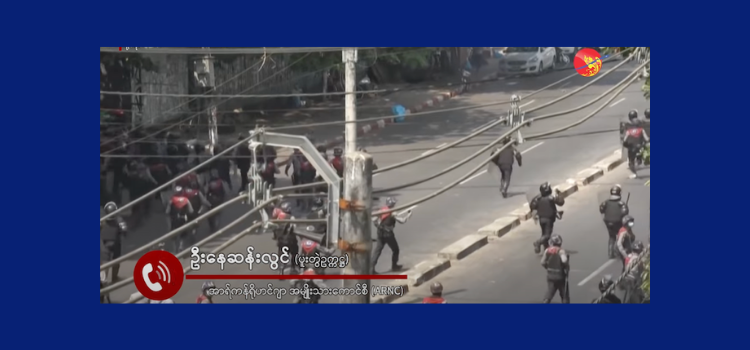
IIMM ရဲ့ နှစ်ပတ်လည် အစီရင်ခံစာနဲ့ ပတ်သက်ပြီး အာရ်ကန်ရိုဟင်ဂျာအမျိုးသားကောင်စီ ပူးတွဲဥက္ကဌ ဦးနေဆန်းလွင်က ဧရာဝတီသတင်းဌာနကို မှတ်ချက်ပေးခဲ့ပါတယ်။

ဒီရုပ်သံတင်းမှာ နားဆင်နိုင်ပါပြီ။

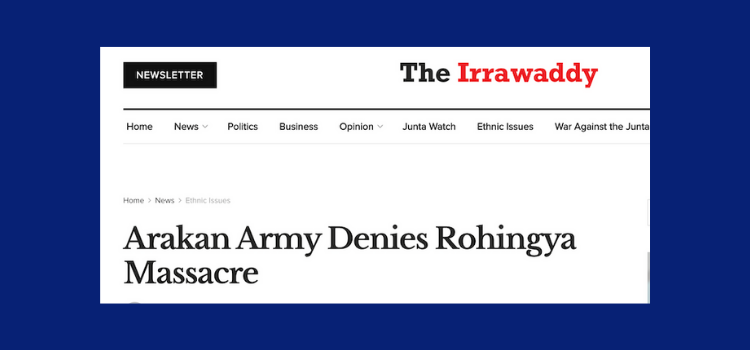
Arakan Army Denies Rohingya Massacre

Arakan Army Denies Rohingya Massacre

By Moe Pyae | The Irrawaddy | August 12, 2025

Ro Nay San Lwin, a co-chair of the Arakan Rohingya National Council (ARNC), posted the photos of skeletons on social media, saying they were of people killed by the AA in Htan Shauk Kham.

In response to the AA’s denial, Ro Nay San Lwin told The Irrawaddy on Monday that his organization has more evidence, including videos and eyewitness accounts.

“Now they can deny it. Later, I believe that there will be responsibility and justice for the people who were killed,” he said.

Read more here.

ရိုဟင်ဂျာ ၆၀၀ ကျော်ကို သတ်ဖြတ်မှုမရှိခဲ့ကြောင်း AA ငြင်းဆို

ရိုဟင်ဂျာ ၆၀၀ ကျော်ကို သတ်ဖြတ်မှုမရှိခဲ့ကြောင်း AA ငြင်းဆို

ဧရာဝတီ | ၂၀၂၅ သြဂုတ်လ (၁၁) ရက်

AA က ထန်းရှောက်ခံကျေးရွာမှာ အစုလိုက်အပြုံလိုက် သတ်ဖြတ်တာမဟုတ်ဘူးလို့ ငြင်းလိုက်တယ်။ အာရ်ကန်ရိုဟင်ဂျာအမျိုးသားကောင်စီရဲ့ ပူးတွဲဥက္ကဌ ဦးနေဆန်းလွင်က ဒီကိစ္စနဲ့ပတ်သက်ပြီး ဧရာဝတီသတင်းဌာနကို မှတ်ချက်ပေးထားပါတယ်။

ဒီရုပ်သံသတင်းမှာ နားဆင်နိုင်ပါပြီ။